Home Blog Page 19

What Are Index Funds and How Do They Work?

Do you look for a smart way to invest? Are you particular about finding a diversified investment? Do you want them to be tax-efficient and low-cost basket of securities? You can get all these things achieved in a bundle from Index funds. 

What are Index Funds, Are index funds Better Than stocks?

As you can understand from the name Index funds are mutual fund investments that invest in stocks. These are not regular stocks. But, they are stocks that look similar to the indexes like BSE Sensex, NSE Nifty in stock market. Index fund’s are managed passively. What does it mean? The fund manager invests in the matching securities available in the underlying index. Also, he does it in the matching ratio and does not make any changes to the portfolio arrangement. Index fund’s are committed to offering investors returns that you can compare to the index that you track.

When you invest in index fund’s, your fund manager will not play an active role in the selection of stocks and industries. He will invest in all stocks that structure the index to be obeyed. You will find one thing here. The weight-age of stocks in the index fund will match and weight-age of every stock in the index. It means that the fund manager will copy the index when building the fund’s portfolio. He will try to retain a portfolio in sync with its index at all times. What if the weight of stock within the index changes? When this happens, your fund manager will try and sell or buy units of the stock. He does it to align its weight in the portfolio similar to the index.

How are Index Funds Different from Actively Managed Funds?

Here are the key factors that differentiate index funds from actively managed funds:

Index Funds – Definition, Risk and Returns

  • Management fee: Index fund management will not cost you more. The reason is that these funds follow the benchmark of popular indexes. On the other hand, actively managed funds need continuous professional management. It means that you will have to pay a higher management fee for these funds.
  • Annual Expense Ratio: Your fund manager need not have to frequently manage index funds. So, these funds carry a low expense ratio. This is not the case with actively managed funds as they need constant monitoring. In turn, the annual expense ratio will be far higher.
  • Risk: The risk in index fund investment allies with its benchmark risk. When it comes to actively managed funds, they can turn riskier. This can happen particularly when they do not perform in line with their benchmark.
  • Objective: The objective of index funds is to counterpart the performance of a particular market index or benchmark. Actively managed funds, always try to outperform the market benchmark.

Advantages of Index Fund Investment:

You might be wondering why to invest in an index fund when there are other investment options available. But, index funds carry many benefits like those mentioned below that make investing in these funds a worthy choice:

  1. Low Costs: In index funds, the composition of a target index includes known numbers. So, as compared to actively managed fund’s, it costs less to run an index fund. Also, the expense ratio of index fund’s is very low as compared to other fund’s. All these factors contribute to lower spending when you invest in index fund’s.
  2. Simplicity: In index funds, the investment goals are easy to understand. Once you are aware of the target index of the index fund, you can identify the type of securities that hold the index fund. Also, management of an index fund is easy and you can do it once every year or once in six months. These two factors make an investment in index funds simple.
  3. Lower Turnovers: Turnover denotes the purchase and sale of securities by a fund manager. When securities are sold, they can attract capital gain taxes. At times, it is passed on to you as an investor. As index fund investments are passive, the turnovers are lower compared to actively managed funds. In turn, you are relieved of capital gain taxes.
  4. No style drift: Style drift is a concept that happens when the managed funds go beyond the purview of their described style. Managed funds do this for increasing returns to investors. These drifts can have a negative impact on the portfolio of an investor. Particularly, this can happen if you have developed your portfolio with diversified investments. On the other hand, it will not happen with the index fund.


What is PPF (Public Provident Fund) – Features & Interest Rate in 2022?

PPF is the short form for the term “Public Provident Fund”. In India, it was launched in 1968. The purpose of its launch is to organised tiny savings as investments. Above all, investors can get returns as well. This is why Public Provident Fund is called a savings-cum-tax saving investment instrument. Apart from helping an individual to save on annual taxes, it can help with building a retirement corpus as well. Are you a person looking for a safe investment? Do you wish to save taxes and earn guaranteed returns? If your answers to these questions are affirmative, PPF Account is the answer for you.

What is a PPF (Public Provident Fund) Account?

Many banks offer the opportunity to create a Public Provident Fund account for customers. It is a popular long-term saving-cum-investment option in India. Banks and other financial institutions in India offer it. It is classified as this type of product because it helps with tax saving, getting returns and assuring safety as well to investors.

In India, the National Savings Institute of the Finance Ministry is the first body to offer a PPF account to the public. From there on, it has improved as an efficient tool for the creation of long-term wealth for investors. When you open a Public Provident Fund account in any bank, you will get it with a 15-year maturity period. Also, you will get the option to extend your investment after 15 years. For a small saver like you, PPF is undoubtedly, an attractive investment instrument. This is because of the tax benefits it offers and also the attractive interest rates.

Who is Eligible to Open a PPF (Public Provident Fund) Account?

If you are an Indian citizen, you are eligible to open a PPF account with any bank in India. You can open this account under Public Provident Fund Scheme and you can get tax-free returns from this account. 

Is non-resident Indians Eligible?

From August 2018, NRIs are not permitted to start a PPF account in India. However, if you have started an account before you turned an NRI, you can continue the existing account for up to 15 years. Once the maturity period reaches, you will have to withdraw and cannot extend.

What are the Key Features of PPF (Public Provident Fund)?

PPF stands unique from other savings instruments due to the following features:

Features of Public Provident Fund

  1. Loan against Public Provident Fund: If you own a PPF account, you can take a loan against the balance you have in this account. But, remember that you can take a loan only after the third year and before the 6th year of your account opening date. Let us consider that you are applying for a loan this year. In this case, you can take a loan equal to 25% of your PPF balance at the end of the previous year.
  2. Taxation Benefit: As a PPF account falls under the EEE category of tax policy, you can get the best tax benefits for this account. EEE means Exempt-Exempt-Exempt according to Indian tax policy. In other words, in the year of your investment, you can claim the amount you invest in PPF as a deduction under sec 80C. Further, the interest you earn from your Public Provident Fundaccount and even the amount you accumulate in this account is free of tax liability.
  3. The Least and the Utmost Investment: The least amount you can invest in your Public Provident Fund  account in any year is Rs.500. So, anybody can invest in this account. In the same way, the utmost amount you can invest in a year is Rs.1.5 lakh in this account. This is again beneficial for those, who are ready to invest this much money in their PPF account in a year to save tax.
  4. Interest Rate for PPF Investment: The government sets the interest rate for PPF. Also, the government pays this interest every quarter. At present, the interest rate applicable to the PPF account is 7.1%. Every month, the amount of interest you get will be calculated. For this, the lowest PPF balance in your PPF account after the 5th of every month until the last day of the money will be considered. Also, the interest will be credited to the Public Provident Fund account itself. The accumulated interest for each quarter is paid by the government at the end of every financial year to your Public Provident Fund account.
  5. Lock-in Period: As mentioned earlier, you will get back the money you invest in a Public Provident Fund account after 15 years. This is the lock-in period from the date of account opening. You can withdraw the money only on maturity. Also, you can extend this tenure to five more years. You can do this only after 15 years. What if you need the money prematurely? Premature withdrawal is permitted. However, you can avail of it only in the case of emergencies.
Conclusion:

So, a Public Provident Fund account carries many benefits and features. It is a safe investment instrument. Of course, the interest rate is fixed at 7.1%. But, you can ensure the safety of your money in this account.

What Are Liquid Funds and How They Works?

Are you new to the term liquid funds? It is a category of the mutual fund. The unique thing about this type of mutual fund investment is that it invests in money market and debt securities. Also, most importantly, these securities carry a maturity of just 91 days maximum. It can include bank term deposits, certificates of deposits, commercial papers and treasury bills to name a few. The assets invested in these funds are not tied up for a longer period. The reason is that liquid funds do not carry a lock-in period. 

You might wonder how much return you can expect from these funds. You cannot expect any guaranteed returns from these funds. Do you know why? The performance of this fund relies upon the market performance. Nevertheless, an investor thinking about better returns prefer these funds against fixed deposits. The reason is that fixed deposits give only a fixed return. But, the chances of better return make liquid funds interesting. When the market booms, more return is possible. But, the risk is more as the market can fluctuate and can even go down at times.

Who Should Invest in Liquid Funds?

Liquid fund’s generally invest in instruments with fixed income. This is done to ensure liquidity to investors and for capital protection. So, the fund managers invest only in high-quality instruments. So, liquid funds are safer compared to other mutual funds. They are indeed risker as compared to fixed deposits. So, are you a person with low to medium risk tolerance ability? Then, you can confidently choose to invest in liquid funds. The reason is that they offer better returns compared to fixed deposits.

How Do Liquid Mutual Funds Work?

The main goal of any liquid fund is to ensure not just liquidity but also capital protection. So, the fund manager ensures the selection of high-quality debt securities for investing. He does it according to the mandate of the scheme. He also makes sure that the average maturity of the portfolio is less than 91 days. The fund manager will try to deliver better results. He will do it by matching the maturity of your portfolio to the maturity of particular securities.


How Are Liquid Funds Beneficial?

When you choose to invest in liquid fund’s, you can expect the benefits listed below:

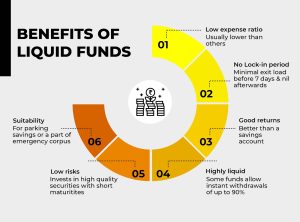
Benefits of Liquid Funds

  • Compared to current and savings bank account, liquid funds can bring better returns. 
  • As the investment is made in instruments that carry high credit ratings, these funds are the least volatile.
  • Most liquid funds do not carry exit loads.
  • As compared to debt funds, liquid fund’s are known to carry the lowest interest rate risk. The reason is that when you invest in these funds, your money is invested by fund managers basically in fixed income securities. Also, the securities carry short-term maturity.

Key Features of Liquid Funds:

  1. Possibility to Invest for a Shorter Period: Do you look for a source to park or invest your money for a short period? Do you look to get the return within a few months or weeks? If so, liquid funds can be the most efficient financial instruments for you. Of course, similar to other mutual funds, you cannot guarantee any return of interest or principal when you invest in liquid fund’s. Nevertheless, the very structure of these funds makes them the right choice for investing funds even for a shorter period. This would be a beneficial move against keeping the money in an interest-earning financial instrument with fixed investment period.
  2. Withdrawal at Any Time: As no fixed term is involved, you have the option to take out your money at any point in time. You will be surprised to know that you can withdraw the funds even the next day of your investing. Moreover, you can earn accrual for every day of your investment.
  3. No Redemption or TDS: As against some instruments, where tax is deducted at the source at the time of redemption, liquid funds do not carry any TDS on redemption.
  4. No Exit Load: The fee charged for exiting the fund before the due date or exit load is not applicable in liquid funds. This rule applies in most cases when investing for a week or longer. So, you can experience a reduction in the investment expenses that are common in other types of mutual fund investments.
Conclusion:

Liquid fund’s are open-ended schemes. Here, the money is invested both in money market instruments and debt with a short maturity period. So, this feature of liquid funds mitigates the risk from volatility in the interest rates. In turn, you can gain high liquidity in your portfolio and can generate stable income. What are you waiting for? Start planning your investment in a liquid fund!

What Is (NPS) National Pension Scheme? How to Open NPS Account?

Are you new to the term NPS? If you are a person interested in saving money through investments, you should know about this scheme for sure. NPS stands for National Pension System. It is nothing but a defined and voluntary contribution retirement savings scheme. The purpose of this scheme is to enable the investors to make the best decisions for their retired life. They can save money right from their working period regularly on this scheme and can reap the benefits after they retire. The scheme aims at nurturing the habit of saving money for the future among the working community. This scheme was started to provide an adequate retirement income for every Indian citizen.

Who Should Invest in NPS (National Pension Scheme)?

Are you a person thinking about planning for your retirement right at a young age? If so, NPS (National Pension Scheme) is a good scheme for you. Also, this scheme is for individuals with a low-risk appetite. A regular income in the form of a pension after you retire will undoubtedly be a boon. This holds particular for individuals retiring from the private sector as they do not get any pension after their retirement. 

You will not deny the fact that a systematic investment like this can make a huge difference in your life after you retire. Even, if you are a person intending to make the most out of 80C tax deductions, this scheme is for you.

What Type of Tax Benefits You Can Get from NPS?

You can get tax exemptions on the contributions you make towards the scheme. However, this exemption is applicable only up to Rs.1.5 Lakhs under section 80C of the Income Tax Act. Let us consider that you and your employer contribute to this scheme for your benefit after retirement. In this case, both the contributions from your end and your employer’s end will be applicable for tax exemption. Here are further details on tax exemption applicable for NPS investment:

  • 80CCD (1) – This is a part under section 80 ELF-contribution. You can claim the utmost deduction of 10% of your salary for tax exemption using this section. Are you self-employed? In this case, the limit is 20% on your gross income.
  • 80CCD (2) – This section covers the contributions that employers make on behalf of their employees towards the (National Pension Scheme) NPS Scheme. So, this section does not apply to self-employed taxpayers. The utmost amount applicable for tax exemption is the lowest of the actual (National Pension Scheme) NPS contribution made by an employer. It also applies as 10% of Basic along with DA and Gross total income. 

Apart from these tax benefits, you can claim any additional self-contribution you make to a maximum of Rs.50,000 under sec. 80CCD (1B) as National Pension Scheme Tax Benefit.

Kinds of (National Pension Scheme) NPS Accounts:

NPS Accounts are basically classified into two kinds. They are individual (National Pension Scheme) NPS Account and Corporate NPS Account. In the first type, the account holder, who is also called the subscriber, is the only contributor. He handles everything including investment choice, scheme preference and annuity service provider. Any Indian citizen can open an Individual (National Pension Scheme) NPS account voluntarily. By doing this, he can avail tax benefits. Also, he can ensure regular income after he retires. The entry age for this type of NPS is 18 to 70 years.

In a Corporate (National Pension Scheme) NPS Account, both the subscriber and his employer contribute to the account holder’s account. For the employees to avail of corporate NPS benefits, the employer will have to register for Corporate NPS for the employees.

In (National Pension Scheme) NPS System, you have the option to open a couple of sub-accounts under the same Permanent Retirement Account Number shortly called PRAN. The sub-accounts are referred to as tiers in NPS. 

  • Tier I: This is also referred to as a pension account. In this case, contributions up to Rs.50,000 are eligible for extra deductions from taxable income under sec. 80CCD (1B). These contributions should exceed Rs.1.5 lakhs under section 80C to be eligible for the deduction. The withdrawals in this case are restricted and are subject to the terms and conditions.
  • Tier II: In this case, you have the option to invest an extra amount in your NPS account. You can withdraw your entire accrued corpus fund under this type at any point in time. What if you have not contributed even the initial money to a tier II account? In this case, the account will be deactivated automatically as per the process. The problem with this account is that no tax benefit is applicable. However, you have the option to transfer funds from Tier II to Tier I. Vice versa is not possible though.

What are International MFs? How To Invest in International Funds?

International funds undoubtedly add an element of geographical diversification to mutual funds. In India, of course, different types of mutual funds exist. Nevertheless, all of them are brought under three main types. They are hybrid, debt and equity mutual funds.

What are International Mutual Funds?

International funds are funds that invest in debt and equity instruments in companies listed outside India. These funds are also referred to as foreign or overseas funds.  If you are an investor looking for long-term investment, you can prefer this fund as an alternative in your investment portfolio. It invests its accumulated money in the stock market of countries like Brazil, Canada, the USA and the UK.

Nowadays, people show interest to invest in mutual funds with portfolio diversification. So, international fund investment is gaining importance in India. A diversified plan in addition to spreading the risk also allows getting into different markets, risk classes and sectors. The good thing about this fund is that it benefits from international stock markets. Nevertheless, it is better to understand the movement of  the market and economic changes in a country before investing. The reason is that these factors can affect the return you get from the international funds.

Who Should Invest in International Funds?

Investment in international funds is best suited for smart investors. This investment is attractive because of the diversification possibility. It will ensure smoother returns. Also, are you looking for exposure to international markets? Yes, it will help with broadening your expertise and experience. In this case, investing in an international fund can be the right choice for you.

Nevertheless, international funds are not for passive investors. The reason is that they will have to keep a continuous watch on the market. They should be sure of their short-term and long-term investment goals before investing. When investing in international funds, these investors will have to check the track record of the funds to ensure the safety of their money.

Why Invest in International Funds?

Higher Diversification:

When your portfolio has only domestic equity and debt mutual funds, your money will be invested only in Indian companies. But, when you have international funds in your portfolio, you can gain additional diversification. Above all, with no or little influence on domestic market conditions, your portfolio can gain better stability.

Not only domestic diversification, you can even achieve currency diversification. This becomes possible by investing in international mutual funds.

Opportunity to Become an Owner of International Market Leaders:

When you invest in international funds, you will get the opportunity to become an owner in some of the biggest businesses. You can get the chance to become the owner of world-known companies like Apple, Adidas and Facebook. In addition to being an owner, you can continue to be a customer of these popular brands. But, you will continue to get a share of the profits that these companies make.

Hedge Against the Risk of Rupee Value Depreciation:

India is an emerging market. So, the currency of our nation is weaker as compared to leading international currencies like Euro and US Dollar. People with liabilities or cash outflows in a foreign currency will experience an impact by depreciation in rupee value. But, when you invest in international funds, a portion of your portfolio can gain the deserving strength from foreign currency. In turn, exposure to foreign currency gets hedged. Above all, any reduction in the value of INR will improve the returns you generate in terms of the dollar. The reason is that it will bring a hike to the per-unit value of your investment. In short, when you invest in international funds, you can expect returns from two sources. One is from the investment itself, while the other is from the depreciation in the value of  Indian National Rupee.

What is IPO And How Does IPO Work?

0

In 2017, India recorded as many as 36 IPOs. Due to this, organization’s were able to raise a record Rs.67,147 crores. They recorded this much in the equity market via IPOs. Now, with this record, you might wonder what made companies raise this much money and what is an IPO. You are in the right place to know more about it here:

What does IPO mean in stocks?:

IPO is the short form for the phrase Initial Public Offering. In this concept, a private company lists its shares on a stock exchange. By doing this, the company makes its shares available for the general public to buy. 

Many people feel that IPOs are big-money-making opportunities. They also feel that high-profile businesses get a place in headlines with huge share price gains. They achieve this when they make their shares available for the public to buy. Of course, they are trendy. Nevertheless, IPOs are risky investments. They are known for delivering inconsistent returns in the long run. Of course, some of them are beneficial. This is why experts say that in IPOs risks and benefits go hand-in-hand.

You can understand IPO as a process, where a private company looks to get help from the public. You might wonder how the IPO can help private companies. The company gets money from the public by selling a portion of its shares. In turn, the company can make some money. 

The public, individuals with high net worth and even institutional investors can do one thing. They can know the details of the initial sale of shares in the prospectus of a company. It is nothing but a lengthy document that provides the details of the proposed offerings.

Once a company does an IPO, its shares are listed and traded freely in the open market. As the company lists its shares in the stock exchange, the exchange will impose a lesser fee on the shares. The exchange can do this either as a ratio of the total share capital or in absolute terms. In some instances, stock exchanges can follow both these approaches.

What is The Purpose of IPO:

What is IPO

Any company, be it young or old can decide to go public. With this decision, the company moves forward to get itself listed in a stock exchange. When they do this, the company can make its shares available to the public by IPO. With the funds that the company gets by selling its shares, the company can raise equity capital. The company has the option to issue new shares through IPOs. Otherwise, the company’s existing shareholders can also sell their shares to the public. In this case, the company cannot raise any fresh capital.

Companies choose IPO as the option to raise capital because they need not have to repay the capital to the public investors. Here, the company that issues its shares is referred to as the issuer. The company can do this with the help of investment banks. After the IPO, the business’s shares will be traded in the open market. Investors can again sell those shares through secondary market trading. 

Apart from raising capital, companies go public to gain popularity as well.

Some Key IPO Terms:

Now, you have an idea of what an IPO is. When you are in this market, it would be good to understand some common IPO Terminologies. Here are a few of them:

Underwriter:

An underwriter is the investment bank that manages the public offerings of an issuing company. This person or entity is responsible for deciding the issue price of shares. Even, the underwriter takes care of the task of assigning shares to investors. The investment bank also assigns shares to investors.

What is IPO Price Band:

The price band is nothing but the price range in which investors can bid for IPO Shares. In general, the price is different for each category of investor. For instance, retail investors like you will pay a different value. But, a qualified institutional buyer might pay a different value for the shares.

What is IPO Lot Size:

This term denotes the smallest number of shares that you can bid for in an IPO. Let us consider that you wish to buy more shares. In this case, you will have to bid in multiples of the lot size.

What are STP and SWP (Systematic Transfer Plan and Systematic Withdrawal Plan)?

For first-time mutual fund investors, three terms are confusing. They are SWP, STP and SIP. You can gain a better understanding of SIP expanded as a systematic Investment Plan here. We will get into the other two terminologies and who should invest in them here. First, SWP stands for Systematic Withdrawal Plan and STP stands for Systematic Transfer Plan. These are distinct concepts in mutual funds with their own unique benefits, uses and features. 

What is SWP and How Does it Work?

SWP is a redemption plan. It permits you to withdraw a particular amount from a fund regularly. It is the opposite of SIP, where you invest systematically, while in Systematic Withdrawal Plan, you withdraw systematically. 

How Does SWP (Systematic Withdrawal Plan) Work?

When you take the case of SIP, you invest small amounts periodically. It means that at the end of a later date, you will end up with a large corpus fund in SIP. On the flip side, in Systematic Withdrawal Plan, you will invest a large corpus fund initially. Thereafter, you will start redeeming a particular amount of money regularly. You can gain a better understanding from the example below:

Let us consider that you are investing Rs.5 lakhs in a debt mutual fund. You are choosing to redeem Rs.5000 every month. When you give this instruction, the fund manager will transfer this money regularly until the value of your investment gets to zero. It means that you can get regular income. This is why SWP (Systematic Withdrawal Plan) is considered the best option for retired people. They wish to invest their retirement benefit in a lump sum and get monthly income to manage their expenses. 

The good thing about (SWP) Systematic Withdrawal Plan is that you have an option. Yes, you can either redeem a particular amount, a particular number of units or all returns above a particular fixed value.

What is STP and How Does it Work?

A Systematic Transfer Plan will provide you with the option to shift your investments from one mutual fund scheme to another. When you have invested in a fund house with many different schemes, this becomes possible. 

How Does STP Work?

You can consider STP as another form of SIP. However, SIP involves the transfer of money from your savings bank account to a mutual fund plan at regular intervals. On the other hand, STP involves the transfer of funds from one mutual fund plan to another. With STP, you can stagger your investment over a particular term to bring down risks and stabilize returns. 

For example, let us consider that you are investing systematically in equities. When you do this, you can achieve risk-free returns even with volatile conditions in the market. Here, an Asset Management Company will permit you to invest a lump sum in one fund. But, the company will provide you with the option to transfer these funds to another scheme systematically. 

When you intend to initiate an Systematic Transfer Plan, you will have to select a couple of funds. The first is the fund from which you wish to transfer the money. The second fund is the one to which the funds should be transferred. Also, you will get the option to choose whether the fund transfer should happen, quarterly, monthly or yearly.

Know the Types of STP:

You will come across three types of Systematic Transfer Plans when you intend to invest. The first is fixed STP, the second is capital appreciation plan and the third option is a flexible plan. In the first type, you can transfer the same amount of money that you fix from one mutual fund to another. In the second type, you can move only the profit you earn from one fund to another fund. Thirdly, in the flexible plan, you can transfer a variable amount. However, in this kind, you will have to decide on a fixed amount that you wish to transfer. Thereafter, the excess money over the fixed amount will rely on the volatility of the market.

Systematic Transfer Plan (STP) will be the ideal choice for those with large money to invest in equities. However, they wish that the investment should happen in a phased manner. So, as against putting a lump sum in an equity fund, you have the option to invest a certain quantity in a liquid fund. This is a good option as liquid funds are known for low risk as compared to equity funds.

How About Taxation on SWPs and STPs?

In both SWP and STP, capital gains tax applies. The reason is that you transfer the money from one fund to another in Systematic Transfer Plan. So, it will be considered redemption. In the case of Systematic Withdrawal Plan, each withdrawal you make will be considered redemption. So, it attracts capital gain tax.

What Are Debt-Based Funds? How Are They Beneficial?

0

Are you new to mutual funds? You can gain a better understanding on what are mutual funds from this page. When you learn about mutual funds from this page, you will also see that there are different types of mutual funds. One such type is debt-based fund. Here, we will gain an understanding of how this type of mutual fund can be beneficial. But, before that let us throw some light on what are debt-based mutual funds:

What are Debt-Based Funds?

A debt based mutual fund is a type of mutual fund investment that focuses mainly on fixed-income instruments. When you invest in this type of mutual fund, your money will be invested in treasury bills, corporate bonds of government securities. At the end of a fixed period, you will get a fixed rate of return when you invest in this type of mutual fund.

Who Should Invest in Debt based Mutual Funds?

Now, you know what debt-based mutual funds are. But, before investing, you will be interested in knowing whether investing in this type of mutual fund will suit you. Let us find out here:

Debt mutual funds are the best option for investors interested in taking moderate risks. In general, mutual fund investment, as you know, is subject to market risks. Nevertheless, as compared to equity mutual funds, debt mutual funds carry less risk. So, you can choose this type if you have a lower appetite for risk. 

Even, this fund suits prospective investors with surplus funds. If you are looking for ways to diversify your investment portfolio, you can choose to invest in these funds. Let us consider that you have a higher equity allocation in your portfolio. In this case, you can bring down the overall risk in your portfolio by investing in debt based fund. The reason is that the debt element can support any downside risk of returns.

How Do Debt Funds Work?

As compared to low-rated securities, debt funds that invest in higher-rated securities are less volatile. Moreover, maturity also relies on the investment strategy of the fund manager. It also relies on the overall rate of interest followed based on the economy. When the fund manager sees a fall in the interest rate regime, he will invest in long-term securities. On the other hand, when he sees an increase in the interest rate regime, he will invest in short-term securities.

Are you still thinking about whether or not to invest in debt-based funds? Then, you should understand the benefits of these funds:

Benefits of Debt-Based Fund-

Better and Greater Liquidity:

Are you looking to invest in a platform with better liquidity? Then, choosing debt-based funds can be the best choice for you. When you do this, as an investor, you will get the option to withdraw your investment in these funds. Above all, the investments that you withdraw from these funds will quickly reflect in your bank account. It will happen within a day. So, you can compare investing in these funds similar to investing in fixed income arenas. But, here, you will not have to get through the huge paper works and penalties. 

Stable Returns:

As an investor, you know one thing for sure. You know that some investments including investment in equity mutual funds will help you get returns only on the basis of market trends. But, the good thing about debt based funds is that their returns do not rely on market sentiments. So, investing in these funds is a safer move if you have a low-risk appetite. Also, debt funds are the best choice if you have some financial goals to be met within a specific period. 

Tax Efficiency: 

It is true that short-term and long-term capital gains taxes are applicable on debt-based funds. But, when you invest in these funds for more than three years, the benefit of indexation will increase after three years. Also, the indexation benefit will increase with each year passing after three years. Further, debt-based funds are not affected by TDS. 

On the other hand, alternative investment options like fixed deposits have a direct deduction of 10.3%. This will happen when your interest income from fixed deposits exceeds Rs.10,000 in a financial year. Income from fixed deposits is taxed every year right from the year of deposit. Nevertheless, you can access the total money earned only when the plan matures. All these hindrances can be eliminated when you invest in debt-based fund.

Stability:

When you invest in debt funds, there will be an increase in the balance in your portfolio. When you take the case of equity funds, they might have higher return potential. Nevertheless, they are volatile. The reason is that the returns from equity funds are associated directly with the market performance. You can considerably diversify your portfolio and can reduce risk in your portfolio by investing in debt funds. 

Flexibility:

You might have different investments in your portfolio. But, the good thing about having debt funds is that you can get the flexibility. You can choose to invest in these funds through SIP. It means that you can invest whenever you get some additional income. Also, you can set a systematic withdrawal plan to easily withdraw the money from your debt fund whenever you need money.

Conclusion:

In short, investment in debt funds is beneficial in many ways. This investment is better than equity funds and even regular fixed deposits in many ways. So, buckle up to ensure an investment area with comparatively lower risk by choosing debt funds.

What Is ETF, How Does ETFs Work and How Many Types They Are?

0

ETF’s – Exchange Traded Funds fall under the category of Index Funds. They are not only listed but also traded on exchanges. You might have heard about stocks being traded in exchanges. ETFs follow the path of stocks in this way. Not only in India, globally, but also ETFs have opened a new panorama of investment chances. 

Particularly, they have opened new investment opportunities to institutional money managers. Even, they help retail businesses. They help investors gain broad exposure to stock markets. Particularly, they provide this exposure at a much lesser cost compared to other investment firms in real-time.

What are Exchange Traded Funds?

An ETF can be called a pool of stocks. They generally reveal the configuration of an index like BSE, Nifty and CNX Sensex. When they are like stocks, you might be wondering how the trading value of an Exchange Traded Funds is decided. Its trading value is decided based on the net asset value of the original stock that it denotes. 

In simple terms, you can think of Exchange Traded Funds as a mutual fund. But, you can sell and buy this mutual fund in real-time. Above all, its price changes all through the day, unlike mutual funds.

Again, ETFs are similar to mutual funds to a certain extent. This similarity lies with the management, regulation and structure of ETFs. Also, similar to mutual funds, ETFs are pooled investment vehicles. They provide different investment opportunities into a varied class of options, currencies, bonds, commodities, stocks or even a combination of these things. 

ETFs are similar to stocks because you can trade them in exchanges similar to stocks. Understanding the difference between open-end and close-end mutual funds will help you. The reason is that you can gain a better understanding of ETFs.

Difference between open-end and close-end mutual funds:

Traditionally, you can buy open-end mutual funds at any time straight from the fund company. Nevertheless, close-end mutual funds provide a set number of shares through Initial Public Offering or IPO. After an IPO, shares can only be purchased from or sold to other shareholders present in the open market.

One of the key differences between open-end and close-end mutual funds is that in the former your counterparty is always the fund company. But, in close-end funds and even in ETFs, your counterparty is not the fund company. But, your counterparty will be shareholders, who trade the entire day. They can either be trading over stock exchanges or directly. So, you can understand that you can trade ETFs at a price that suits you the most.

Are close-end mutual funds and Exchange Traded Funds are similar?

They are not the same. However, they are close cousins. The reason is that you can buy and sell both of them in stock exchanges. But, the difference between these two funds is that ETFs are not actively managed. Rather, the securities in an ETF just form a pool of investments. These pools intend to imitate an index as similar as possible. 

How To Choose Exchange Traded Funds and Index Funds?

When you intend to invest in ETFs, you will have to consider three main parameters. They are liquidity, tracking error and total expense ratio. Here are some details to know about these parameters:

Liquidity: 

As against mutual funds, ETFs are bought and sold in stock exchanges. So, liquidity is an essential factor to consider. When an ETF is not liquid, you might not be able to find buyers when you intend to sell the fund.

Tracking Error: 

The difference between the index and ETF return is referred to as tracking error. This is a crucial parameter considering the performance. The reason is that as an investor, you are actually going to invest in the index.

Total Expense Ratio: 

The total expense ratio should be of the low-risk category.

How Does Exchange Traded Funds Work’s?

As mentioned earlier, ETFs share the characteristics of both mutual funds and shares. They are bought and sold in the stock market as shares produced through creation blocks. You can buy or sell them from or to popular stock exchanges during the equity trading time. When you see changes in the prices of ETFs, it can happen due to changes in the cost of underlying assets. Let us consider that the price of one or more assets increases. When this happens, the price of ETF will also rise in the same proportion.

The shareholders in ETF will get dividends based on the asset management and asset performance of the particular ETF Company. As per the norms that the company follows, these assets can either be managed vigorously or inertly. A portfolio manager will take care of actively managed ETFs. He will do it after cautiously evaluating the conditions in the stock market. When assessing, he will undertake a calculated risk. He will do it by investing in companies with high potential. On the other hand, passively managed assets follow the trends of particular market indices. In this case, the investment is done only in the companies that are listed on the rising charts.

Types of Exchange Traded Funds:

Before you invest in ETFs, it is better to know their types. In fact, different types of ETFs exist. However, only four of them are popular. They are currency ETF, Debt ETF, Gold ETF and Equity ETF.

Conclusion:

Exchange-Traded Funds are profitable investment options for institutional money managers and retail business owners. So, you can choose this investment option and can reap the benefits thereof.

Taxation on Mutual Funds – An Eye-Opener for Your Financial Planning!

Mutual Fund Taxation – How Mutual Funds Are Taxed?

Do you have financial goals to be met in a few years? If your answer is affirmative, mutual funds are among the most interesting investment options available to you. Apart from providing wealth-generation opportunities, these financial instruments are tax-efficient as well. Of course, investing in fixed deposits is a practice that is followed for a long. But, investing in fixed deposits carries a great disadvantage. This holds particularly for people in the highest income bracket in India. The reason is that interest from fixed deposits is added to the taxable income. Then, the total is taxed at their income tax slab rate. With mutual funds, you can expect tax-efficient returns and effective money management.

Taxation on Mutual Funds

What Type of Tax Benefits You Can Get From Mutual Funds?

One factor makes mutual fund investments good. It is that the taxation on mutual funds gets into the picture only when you sell the units of a mutual fund scheme. You might wonder what other kinds of tax benefits you can get when investing in mutual funds. You can get a better idea here:

Taxes on Equity Mutual Funds:

Equity mutual funds are funds with a minimum of 65% of equity allocation in the investment portfolios. For long-term capital gains in these funds, the least holding period is one year. When you sell the units before one year, you will have to pay tax at 15% along with a 4% cess. When you sell after one year, the long-term capital gains tax percentage is 10% plus 4% cess. However, this rule applies only when the capital gain in a financial year is more than Rs. 1 lakh. The good thing here is that if the long-term capital gain is less than a lakh, it is entirely free of taxes.

For individual investors like you, the dividends you get on equity mutual funds are free of taxes. However, it is taxable at 11.648% for Asset management companies. These companies will have to pay this tax in the name of Dividend Distribution Tax.

Taxes on Debt Mutual Funds:

When it comes to debt mutual funds, the least hold period for short-term capital gains is three years. If the units are sold before these three years, the tax percentage will vary based on the tax bracket of the investor. For instance, if you come under the tax bracket of 30%, the short-term capital gains tax rate will be 30% plus 4% Cess to you. After three years, it turns out to be long-term capital gain. In this case, the tax percentage is 20% with indexation. 

What Does Indexation In Mutual Funds Mean?

Indexation is a process using which the price of acquiring mutual fund units can be inflated or adjusted. This can be done over a period to bring it to the present price after considering inflation. It gives you the option to increase the price of purchasing.

To evaluate your capital gains with indexation, you will have to index the cost at which you bought the mutual fund units. You can do this by multiplying this cost with the ratio of the cost of inflation index when you sell and the cost of inflation index of your purchasing year. Thereafter, you will have to subtract the indexed purchasing cost from the value of sales. When you invest in debt funds, indexation benefits will help with bringing down your tax obligation considerably. This is in comparison with investment in bank Fixed Deposits and other small savings schemes.

You can understand this concept better with the example below:

Mr. Akilesh invested Rs. 2 Lakhs in a mutual fund scheme in May 2016. At the time of redemption after three years, in May 2019, the investment value has turned into Rs.2.2 lakhs. So, the capital gain here is Rs.2.2-Rs.2 lakhs, which is Rs.20000. For this value, Mr. Akilesh paid a long-term capital gain. But, indexation adjusted the value of purchase of Rs.2 lakhs based on inflation. It means that the cost of purchase increases and capital gain reduces for tax purposes.

The cost of inflation index (notified values) for the year 2016-2017 and 2019-20 when the purchase and sale were made respectively by Mr. Akilesh are 264 and 289. So, the calculation is as follows:

289/264*2,00,000 = Rs/218939.3939. Now, the capital gain should be calculated as Rs.2,20,000-218939.3939 = Rs.1060.6061. So, you are not going to pay tax on the actual capital gain of Rs.20000, but, you will pay reduced tax for Rs.1060.6061 as per the example above.

Even in this case, dividends are tax-free for investors. In the case of fund houses, they are taxed as Dividend Distribution Taxes at 29.120%. 

Taxes on Hybrid Funds:

You can learn about Hybrid funds from our previous article. these funds are also called balanced funds. The tax rate on capital gains on these funds relies on the equity exposure of your portfolio. Just in case, the equity exposure is more than 65%, the fund scheme is taxed similar to an equity fund. If this does not happen, the taxation on mutual funds rules similar to debt funds apply for the hybrid fund. Here is a table to give you a better idea for different types of taxation on mutual funds investments:

Type of fund

Long-Term Capital Gain

Short-Term Capital Gain

Equity Funds Tax exemption for up to Rs.1 lakh per year. Any gains over this amount will be taxed at 10% plus cess plus surcharge 15% plus Cess plus surcharge
Debt Funds 20% plus cess plus surcharge Taxed at the income tax slab rate of the investor
Hybrid equity-oriented funds Same as equity fund 15% plus cess plus surcharge
Hybrid debt-oriented funds Same as debt fund Same as debt fund

Capital Gains Taxation when invested through SIPs:

A systematic investment plan or SIP is an investment method in mutual funds. The purpose of this investment method is to help investors to invest a small amount of money periodically in mutual fund schemes. It means that they can invest whenever they get money. They are at liberty to choose the frequency of their investment like annually, two times a year, four times a year or even 12 times a year.

Capital Gains Taxation

When you choose this investment method, you have the option to shop for a particular number of MF units in instalments. In this case, the redemption of units is calculated on a FIFO basis. Let us consider that you plan to invest in mutual funds through SIP for a year. Also, you decide that you should redeem the entire money after 13 months. In this case, the units that you shopped in the first month will be considered long-term. So, the income you gain from these units will be calculated as long-term capital gains.

If the value is less than a lakh, you need not have to pay any tax. But, the units you purchase from the second month will be considered a short-term investment. The money you gain from the sale of these units will be considered as short-term capital gains. So, these gains will be taxed at 15% flat based on your income tax slab. Also, you will have to bear the applicable surcharge and cess.